 Veronika Kováčová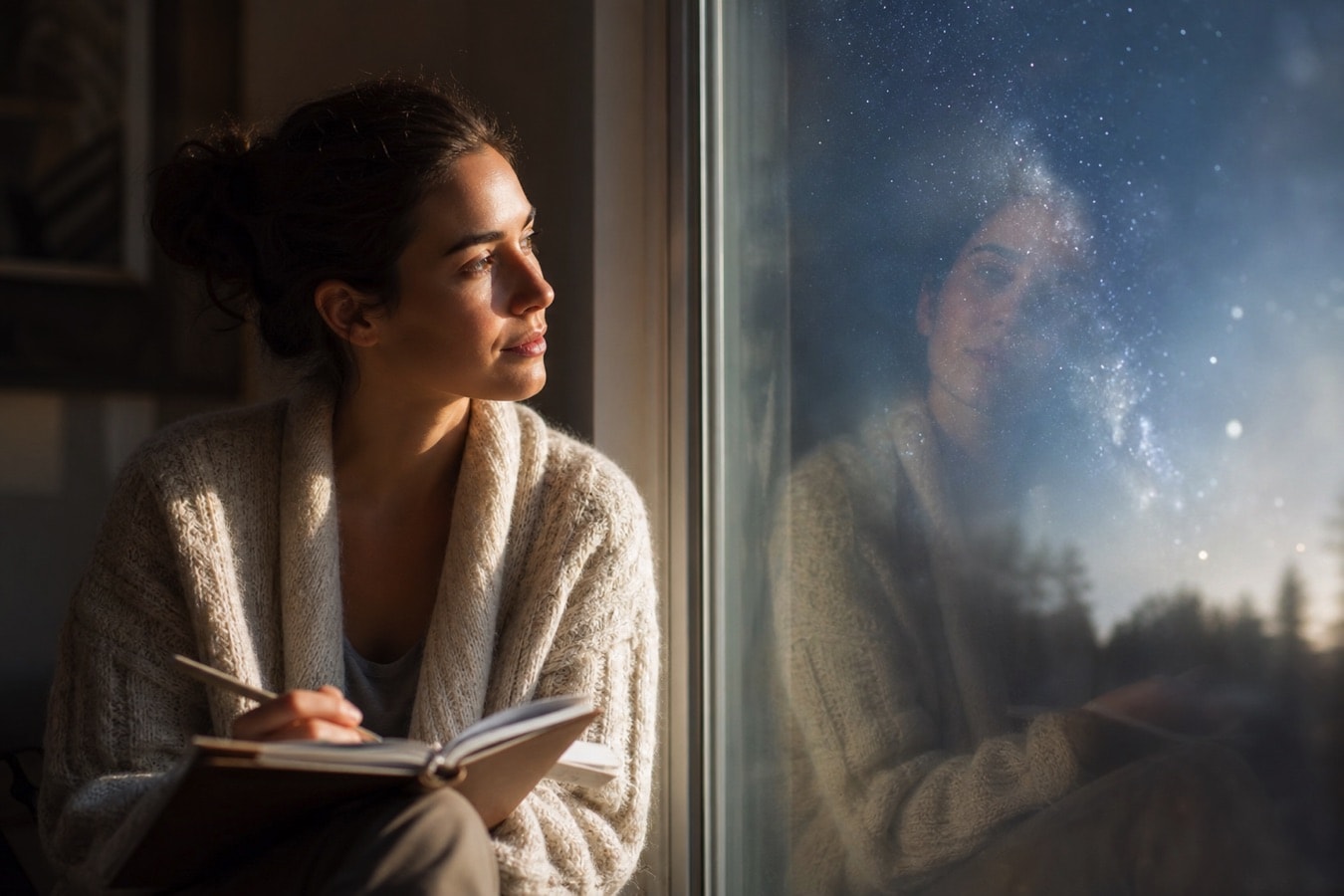
Prediction promises certainty. It tells you what will come—or at least hints at a direction to prepare. Mindfulness does something else: it does not add information about the future; it adds capacity to be in the present without instant judgment. With horoscopes those two modes often mix. You read the text as prediction—and the body tightens. Or you read it as a mirror—and the body may find a little room to breathe.
The difference is not academic. It is the difference between owning your day and living it as a series of tests you must “pass” according to something you read in the morning.
On the page about science and horoscopes, we remind readers astrology is not science in the traditional sense. Why write about mindfulness here? Because how you read a horoscope can train attention—or train anxiety. It depends on framing.
What prediction does to the psyche
Prediction creates expectation. The brain then hunts confirmation—and often falsification too, but the first works stronger. If a horoscope warns of conflict, you may stay tense all day and one sharp tone in a message “proves” it fit. Maybe you would have heard that tone differently had you not primed for threat in the morning.
That is not about whether the horoscope “is right.” It is about how attention filters the world. We talk about filters in the article on cognitive biases and in the text on the Barnum effect.
What mindfulness does
Mindfulness—in the sense of attention to the present moment—does not require a cushion or forest quiet. It can be: notice breath, notice shoulders, notice whether you are hungry. These micro-observations lower automatic interpretations (“they insulted me”) and make room for a question (“what exactly hurt?”).
You can read a horoscope mindfully by not taking it as a court ruling, but as an invitation: if peace were today’s theme, what would I do differently right now? That is not prediction; it is a creative question. And questions return power to you.
Prediction as escape from uncertainty
Uncertainty is costly in energy. Prediction promises to shrink uncertainty with a map. Sometimes it helps temporarily—someone sleeps calmer. Trouble begins when the map replaces the compass: when we stop listening to our body because “the stars said something else.”
That is why pairing a horoscope with self-reflection makes sense—not to cancel the horoscope, but to have a second information source: your own experience.
Children, aging parents, and the language of prediction
In families predictive language shows up often: “you’ll regret it,” “you’ll never achieve anything this way.” It may come from a loving person’s anxiety, but in a child’s or adult child’s body it sounds like a verdict. Mindful language would sound different: “I’m afraid for you because…”—there is room for dialogue instead of a closed script.
It is not only a family theme; partnerships work similarly. Prediction like “you’ll leave me anyway” builds an environment where the other feels judged in advance. Mindfulness would name fear without sentencing the future. If that dynamic resonates, pair it with work on self-reflection—not to “fix character,” but to see your own words more clearly.
A practical one-day experiment
Try reading the horoscope in the morning, then write one sentence: “If I took this as prediction, what would I expect?” And another: “If I took this as mindfulness, what one extra thing would I notice today?” You need not pick the “right” option—the point is to see which mode makes the day lighter or heavier.
Connection to intuition and slowing
Intuition often comes fast; mindfulness can accompany it so you do not confuse it with panic. More on intuition in the article on the psychology of intuition. Slowing creates space between stimulus and conclusion—exactly where you can choose a predictive or mindful stance. See slowing down and thinking.
Why people love horoscopes—and yet they sometimes harm
A horoscope can be a beautiful linguistic form: metaphorical, poetic, human. The problem is not aesthetics; the problem is the power relation between text and reader. If the reader has no right to say “this is not me,” the text becomes superior. Mindfulness restores the right to say no—not as rejection of fun, but as respect for your own complexity.
We wrote about why we lean toward believing general texts in why people believe horoscopes. It is part of a broader human wish for understanding we also explore in searching for meaning.
Technology and the predictive brain
Recommendation algorithms are prediction machines: “you might like…,” “next video…” The brain learns to expect the world will serve the future as bait. That can be fun, but it can also weaken tolerance for uncertainty. Then a day without a clear plan can feel empty—not because it is empty, but because we are used to constant next stimuli.
Mindfulness toward your own day is a small act of resistance here—not aggressive, but human. Instead of another recommendation, you notice light in the room, taste of food, tiredness in your legs. Those details look “weak” at first glance; in fact they are connection to reality no prediction replaces.
Two questions before sleep
If you want to train mindfulness instead of prediction, try in the evening: “What did I actually experience today?” and “Where was I present and where was I in a scenario?” The goal is not perfect observation; the goal is gently weakening the habit that life must be understandable in advance to be legitimate.
A horoscope can stay in this ritual as part of the day—just do not make it the only source of interpretation. If your body answers those questions better than the text, good news: the compass is coming home.
A short note on belief and practice
This text is not about whether to “believe” or “not believe.” It is about how practice affects the psyche. If practice makes the day lighter and kinder, it makes sense. If it makes the day heavier, it makes sense to adjust—without dramatic vows, with gentle attention to consequences. Maturity is often exactly that ability: adjust tools, not fight for them.
Conclusion: the best horoscope is one that does not steal your day
Whatever you read, a measure can be simple: after reading, are you more present, or more in your head? If more in the head with worry, try shifting frame toward mindfulness. If more present, maybe you found a way to use language kindly toward yourself.
Texts are tools. A tool can cut or heal—it depends on the hand holding it and the intention reaching for words. Your hand and your intention matter more than any headline.
Horoscope Eng wants to be a place of gentle invitation, not pressure. Prediction and mindfulness need not be enemies—but they should know who holds the keys to your calm.
If after this text you cannot pick a “side,” you understood the point: it is about flexibility. Sometimes you need language that gives direction, sometimes language that gives breath. Both can be learned—and both can be lost if you press too hard to one side of the barricade.
Next time you close the horoscope page, ask: was I with it, or was I already in tomorrow? Presence is not a trendy meme; it is the only place where the day can truly be adjusted.